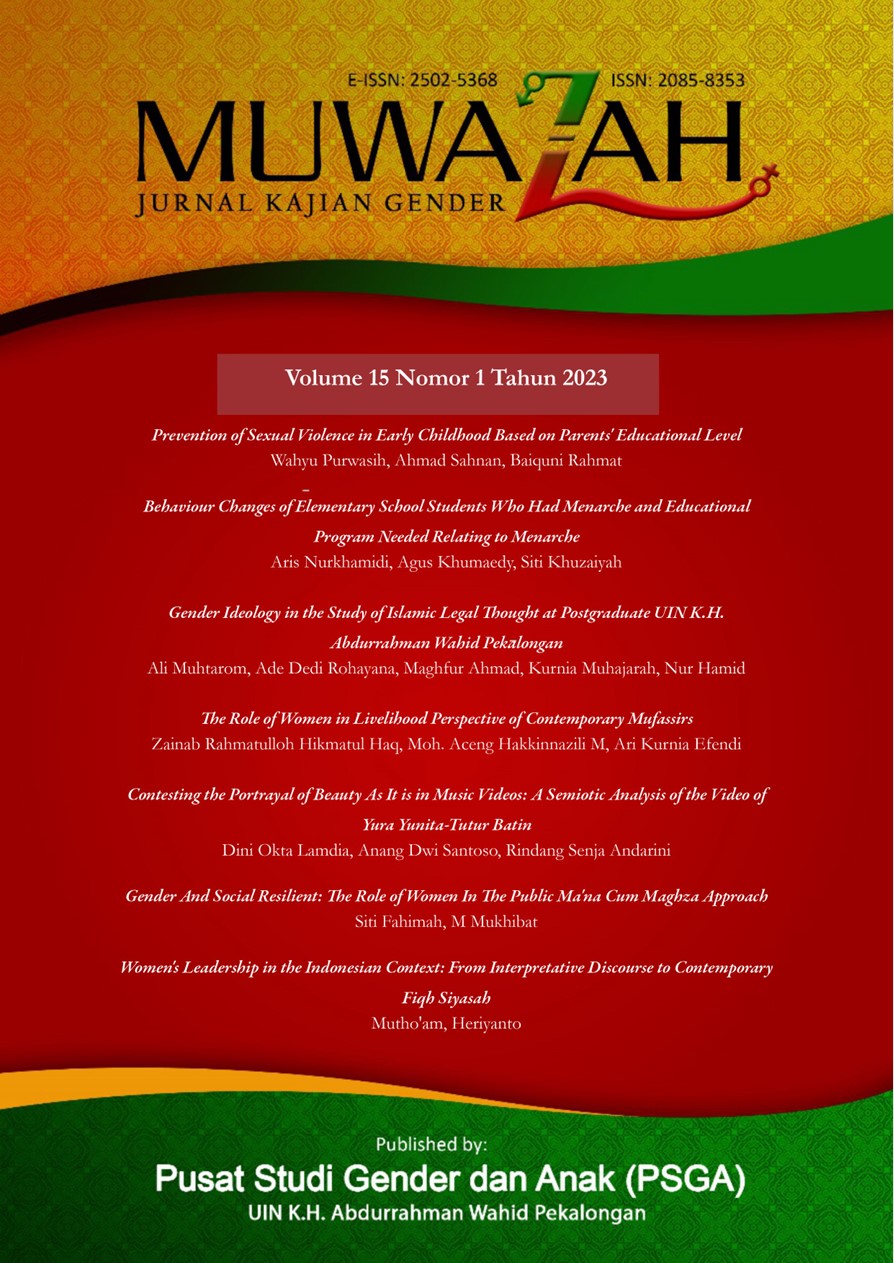
Contesting the Portrayal of Beauty As It is in Music Videos: A Semiotic Analysis of the Video of Yura Yunita-Tutur Batin
DOI:
https://doi.org/10.28918/muwazah.v15i1.2285Abstract
Recently, "beauty as it is" has been featured in commercials for beauty products, movies, and music videos. This concept arose from a lengthy conversation about normative beauty, according to which a beautiful lady is always characterized by having fair complexion, straight hair, and a fresh face. This study, in response to these developments, challenges if, in the manufacture of "beauty as it is," capitalists continue to use women's bodies as commodities instruments, not only beauty and sexiness but also women's flaws and powerlessness. In more detail, this study employs a critical paradigm, Roland Barthes' semiotic analysis, and Stuart Hall's representation theory to deconstruct the denotation, connotation, and myths that form in the music video for Yura-Yunita-Tutur Batin. Findings of this study indicates that women who do not adhere to beauty norms would face prejudice. The prevalence of beauty privilege is damaging not just to women who are far from beauty standards, but also to gorgeous women, who are regarded as having beauty capital alone. The female body is once again objectified in this video. Women's physical appearances are shown in a variety of ways by expressing themselves as they are, but the music video nonetheless builds conventional standards of beauty. The body positivity campaign resulted in poisonous body positivity, and women supporting women was only carried out by women with the same physical issues, while the rest depicted women dropping other women.
Keywords:
References
Afful, A. A., & Ricciardelli, R. (2015). Shaping the online fat acceptance movement: talking about body image and beauty standards. Journal of Gender Studies, 24(4), 453–472. https://doi.org/10.1080/09589236.2015.1028523
Afriani, S. H. (2012). Islamic beauty: Socio-semiotic analysis of facial foam and body lotion advertisement. Journal of Indonesian Islam, 6(2), 265–278. https://doi.org/10.15642/JIIS.2012.6.2.265-278
Álvarez-Cueva, P., Figueras-Maz, M., & Medina-Bravo, P. (2021). Evolution of heteronormativity through a categorization of gender stereotypes. Analysis of the most popular music videos | Evolución de la heteronormatividad a partir de una categorización de los estereotipos de género. Análisis de los videoclips musicale. Profesional de La Informacion, 30(5). https://doi.org/10.3145/epi.2021.sep.01
Barthes, R. (2013). Applying semiotics. In Communication Studies: The Essential Resource.
Bissell, K. L. (2010). Exploring the influence of mediated beauty: Competitive female athletes’ perceptions of ideal beauty in athletes and other women. In Examining Identity in Sports Media. https://doi.org/10.4135/9781452274904.n3
Bissell, K. L., & Chung, J. Y. (2009). Americanized beauty? Predictors of perceived attractiveness from US and South Korean participants based on media exposure, ethnicity, and socio-cultural attitudes toward ideal beauty. Asian Journal of Communication, 19(2), 227–247. https://doi.org/10.1080/01292980902827144
Boero, M. (2015). The bodies of mothers. The censorship of Jade Beall’s photographs | The bodies of mothers: Il corpo censurato e gli scatti di Jade Beall. In Lexia (Vols. 21–22). https://doi.org/10.4399/978885489127213
Brown, J. D., & Campbell, K. (1986). Race and Gender in Music Videos: The Same Beat but a Different Drummer. Journal of Communication, 36(1), 94–106. https://doi.org/10.1111/j.1460-2466.1986.tb03041.x
Carpio-Jiménez, L., Cumbicos-Ruilova, J., & Puertas-Hidalgo, R. (2022). Reggaeton music videos on YouTube. Policies on gender stereotypes | Videoclips musicales del reggaetón en YouTube. Políticas sobre estereotipos de género. Iberian Conference on Information Systems and Technologies, CISTI, 2022-June. https://doi.org/10.23919/CISTI54924.2022.9820483
Conesa-Agüera, A., Jiménez-Ruiz, I., Almansa-Martínez, P., & Juliá-Sanchís, R. (2019). Design and validation of the social assimilation of beauty and body image stereotypes questionnaire in Spain. Health Care for Women International, 40(11), 1268–1282. https://doi.org/10.1080/07399332.2019.1590359
Copeland, S. (2019). Telling stories of terrorism: a framework for applying narrative approaches to the study of militant’s self-accounts. Behavioral Sciences of Terrorism and Political Aggression, 11(3), 232–253. https://doi.org/10.1080/19434472.2018.1525417
Eroğlu, E., & Eroğlu, S. Y. (2020). Investigating BMI, fatphobia and dietary habits of individuals going to the gym. Progress in Nutrition, 22, 19–27. https://doi.org/10.23751/pn.v22i1-S.9776
Faber, J., & Berto, P. M. (2010). Shared brain activity for aesthetic and moral judgments: Implications for the Beauty-is-Good stereotype | As atividades cerebrais de julgamento da beleza e da moral são divididas e possivelmente explicam o estereótipo Belo-é-Bom. Dental Press Journal of Orthodontics, 15(3), 16–18. https://doi.org/10.1590/S2176-94512010000300002
Gillborn, S., Rickett, B., & Woolhouse, M. (2022). A Feminist Relational Discourse Analysis of mothers’ voiced accounts of the “duty to protect” children from fatness and fatphobia. Feminism and Psychology, 32(2), 224–245. https://doi.org/10.1177/09593535221074802
Godlewsky, T. (2019). Female Musicians’ Visual Gender Staging in Music Videos. Cubic Journal, 2, 32–47. https://doi.org/10.31182/cubic.2019.2.016
Greeson, L. E. (1991). Recognition and Ratings of Television Music Videos: Age, Gender, and Sociocultural Effects. Journal of Applied Social Psychology, 21(23), 1908–1920. https://doi.org/10.1111/j.1559-1816.1991.tb00513.x
Gurstein, R. (2002). The elgin marbles, romanticism & the waning of “ideal beauty.” Daedalus, 131(4), 88.
Haddon, M. (2019). Warp’s music videos: Affective communities, genre and gender in electronic/dance music’s visual aesthetic. Journal of British Cinema and Television, 16(4), 571–590. https://doi.org/10.3366/jbctv.2019.0499
Hall, S., Evans Jessica, & Nixon, S. (2013). Representation: Cultural Representation and Signifying Practices. Sage in association with the Open University. https://uk.sagepub.com/en-gb/eur/representation/book234567
Jones, C. (2010). Materializing piety: Gendered anxieties about faithful consumption in contemporary urban Indonesia. American Ethnologist, 37(4), 617–637. https://doi.org/10.1111/j.1548-1425.2010.01275.x
Kiilerich, B. (2007). Picturing ideal beauty: The saints in the Rotunda at Thessaloniki. Antiquite Tardive, 15, 321–336. https://doi.org/10.1484/J.AT.2.303126
Kost, C., & Jamie, K. (2022). “It has literally been a lifesaver”: the role of “knowing kinship” in supporting fat women to navigate medical fatphobia. Fat Studies. https://doi.org/10.1080/21604851.2022.2041295
Langnes, T. F., & Walseth, K. (2022). This is what I learned about the body on social media: PETE students’ experiences with body pressure and body positivity. Sport, Education and Society. https://doi.org/10.1080/13573322.2021.2022642
Leboeuf, C. (2021). What Is Body Positivity? The Path from Shame to Pride. Philosophical Topics, 47(2), 113–127. https://doi.org/10.5840/PHILTOPICS201947218
Legault, L., & Sago, A. (2022). When body positivity falls flat: Divergent effects of body acceptance messages that support vs. undermine basic psychological needs. Body Image, 41, 225–238. https://doi.org/10.1016/j.bodyim.2022.02.013
Low, M. B. (1993). Women’s body image: the nurse’s role in promotion of self-acceptance. AWHONN"s Clinical Issues in Perinatal and Women"s Health Nursing, 4(2), 213–219.
McLoughlin, L. (2013). Crystal clear: Paler skin equals beauty - a multimodal analysis of Asiana magazine. South Asian Popular Culture, 11(1), 15–29. https://doi.org/10.1080/14746689.2013.764639
Millard, J. (2009). Performing beauty: Dove’s “real beauty” campaign. Symbolic Interaction, 32(2), 146–168. https://doi.org/10.1525/si.2009.32.2.146
Murray, D. P. (2013). Branding real social change in Dove’s Campaign for Real Beauty. Feminist Media Studies, 13(1), 83–101. https://doi.org/10.1080/14680777.2011.647963
O’Kelly, M. (2013). Self-acceptance in women. In The Strength of Self-Acceptance: Theory, Practice and Research. https://doi.org/10.1007/978-1-4614-6806-6_13
Payne, L. G. (2010). Self-acceptance and its role in women’s recovery from addiction. Journal of Addictions Nursing, 21(4), 207–214. https://doi.org/10.3109/10884602.2010.515693
Putz, Á., Kocsor, F., & Bereczkei, T. (2018). Beauty stereotypes affect the generalization of behavioral traits associated with previously seen faces. Personality and Individual Differences, 131, 7–14. https://doi.org/10.1016/j.paid.2018.04.011
Qiao, F., & Wang, Y. (2022). The myths of beauty, age, and marriage: femvertising by masstige cosmetic brands in the Chinese market. Social Semiotics, 32(1), 35–57. https://doi.org/10.1080/10350330.2019.1682279
Rwubaka, T. D., & Prieler, M. (2022). Gender Representation in Rwandan Music Videos. Communicatio, 48(2), 1–20. https://doi.org/10.1080/02500167.2022.2105924
Salazar, S. G. (2020). Lexicon and ideology on fatphobia in digital communication | Léxico e ideología sobre la gordofobia en la comunicación digital. Circulo de Linguistica Aplicada a La Comunicacion, 83, 93–107. https://doi.org/10.5209/clac.70566
Sawer, M. (2006). When women support women...: EMILY’s list and the substantive representation of women in Australia. In Representing Women in Parliament: A Comparative Study. https://doi.org/10.4324/9780203965672
Sayce, O. (1982). “Si wunderwol gemachet wîp (L 53,25ff.)”: A variation on the theme of ideal beauty. Oxford German Studies, 13(1), 104–114. https://doi.org/10.1179/ogs.1982.13.1.104
Shabudin, M., & Aman, I. (2012). Discourse and ideology in advertisements of beauty products in the Japanese language | Wacana Dan Ideologi Iklan Produk Kecantikan Berbahasa Jepun. GEMA Online Journal of Language Studies, 12(3), 789–816.
Simon, K., & Hurst, M. (2021). Body Positivity, but not for everyone: The role of model size in exposure effects on women’s mood, body satisfaction, and food choice. Body Image, 39, 125–130. https://doi.org/10.1016/j.bodyim.2021.07.001
Smith, S. M., McIntosh, W. D., & Bazzini, D. G. (1999). Are the beautiful good in Hollywood? An investigation of the beauty-and-goodness stereotype on film. Basic and Applied Social Psychology, 21(1), 69–80. https://doi.org/10.1207/s15324834basp2101_7
Stewart, A. (2016). Quiet beauty: problems of agency and appearance in evangelical Christianity. Religion, 46(1), 32–52. https://doi.org/10.1080/0048721X.2015.1042990
Stoll, L. C., & Egner, J. (2021). We must do better: Ableism and fatphobia in sociology. Sociology Compass, 15(4). https://doi.org/10.1111/soc4.12869
Stoll, L. C., Meadows, A., von Liebenstein, S., & Carlsen, C. E. (2022). Fatphobia. In Global Agenda for Social Justice 2.
Suleymani, S. (2020). Futurities of Beauty and the Scalpel: Cosmetic Surgeries and Fatphobia in Iran. Fat Studies, 9(3), 204–219. https://doi.org/10.1080/21604851.2019.1641396
Vassallo, C. (2017). For a comparison between Plotinus and the Anonymous on the Sublime on the ideal beauty | Per un confronto tra Plotino e l’Anonimo del Sublime sulla bellezza ideale. Giornale Critico Della Filosofia Italiana, 96(1), 9–17.
Vendemia, M. A., & Robinson, M. J. (2022). Promoting body positivity through stories: How protagonist body size and esteem influence readers’ self-concepts. Body Image, 42, 315–326. https://doi.org/10.1016/j.bodyim.2022.07.005
Ward, M. (2022). Fatphobia and Inequities in Scarce Resource Allocation: Reflections on CSC Planning Two Years Later. International Journal of Feminist Approaches to Bioethics, 15(1), 100–101. https://doi.org/10.3138/ijfab-15.1.07
Yan, Y., & Bissell, K. (2014). The Globalization of Beauty: How is Ideal Beauty Influenced by Globally Published Fashion and Beauty Magazines? Journal of Intercultural Communication Research, 43(3), 194–214. https://doi.org/10.1080/17475759.2014.917432
Downloads
Published
License
Copyright (c) 2023 MUWAZAH: Jurnal Kajian Gender

This work is licensed under a Creative Commons Attribution 4.0 International License.