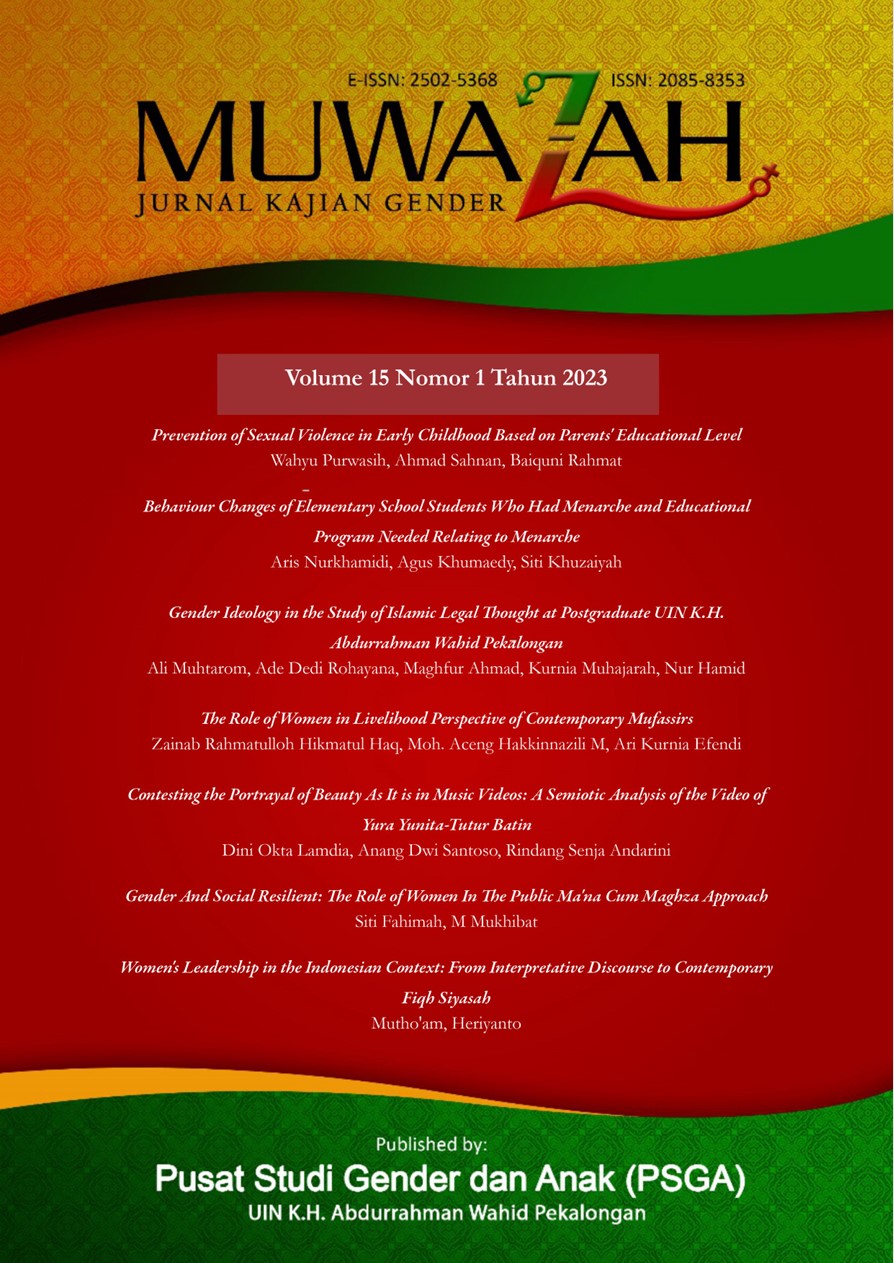
The Role of Women in Livelihood Perspective of Contemporary Mufassirs
DOI:
https://doi.org/10.28918/muwazah.v15i1.1507Abstract
The purpose of this study is to describe problems related to livelihood according to the perspective of Contemporary Mufassir. Scholars agree that a living is borne by the husband in meeting household needs, but in the contemporary era it is often found that women work outside the home as the main support for breadwinners in meeting household needs. Some say that it is natural for women to stay at home, but we often encounter the phenomenon of women as breadwinners outside the home. The author wants to examine the issue of subsistence from the perspective of Contemporary Mufassir, Sheikh Mutawalli Sya'rowi, M. Quraish Shihab and Buya Hamka. The writing method uses descriptive qualitative research with the type of Library Research. The primary source comes from the book of Tafsir As-Sya'rawi, Tafsir Al-Mishbah, Tafsir Al-Azhar. Data collection techniques from documentation with qualitative content analysis as the analysis technique. The results of the research in general show that the three mufassirs allow women to work for a living. As-Sya'rawi and Quraish Shihab both clearly stated the permissibility of working for women. As for Buya Hamka, he allowed it, but he seemed to emphasize more on women to stay at home.
Keywords:
References
Ahmed, I. and Brasted, H. (2020) ‘Recognition and Dissent: Constitutional Design and Religious Conflict in Pakistan’, Journal of Contemporary Asia, pp. 351–367.
Al-Sya’rawi, M.M. (no date) Al-Mar’ah fi al-Qur’an. al-Qahirah.
Ali, I. dan U. (2015) ‘Hadiah Pernikahan Terindah Menuju Sakinah, Mawaddah, Wa Rahmah’.
Alteneiji, E. (2023) ‘Value changes in gender roles: Perspectives from three generations of Emirati women’, Cogent Social Sciences, 9(1). Available at: https://doi.org/10.1080/23311886.2023.2184899.
Aniroh, R.N. (no date) ‘Hak dan Kewajiban Suami Istri (Kritik Realitas atas Aturan Hukum Keluarga di Indonesia)’.
Arifin, Z. (2020). Karakteristik Tafsir Al-Mishbah. AL-IFKAR: Jurnal Pengembangan Ilmu Keislaman, 13.
Asy-Sya’rawi, M.M. (no date) Tafsir al-Sya’rawi.
Azzuhri, M. (2013) ‘Khadijah Binti Khawailid Ra Sosok Perempuan Karier’, Muwazah, 1(2), pp. 91–99. Available at: https://doi.org/10.28918/muwazah.v1i2.283.
Berutu, A.G. (2019). Tafsir Al-Misbah Muhammad Quraish Shihab. Available at: https://doi.org/10.31219/osf.io/9vx5y.
Budiana, Y. (2021) ‘Kekhasan Manhaj Tafsir Al-Mishbah Karya M. Quraish Shihab’, 1(1), pp. 85–91.
Buya Hamka (1983) Tafsir al-Azhar. Jakarta: Pustaka Panji.
Fadilah, S. (2018) ‘Kesetaraan gender : Fenomena pergeseran peran ekonomi wanita dari tulang rusuk menjadi tulang punggung’, Gender dan Anak, 1(1), pp. 18–26.
Ginting-Carlström, C.E. and Chliova, M. (2023) ‘A discourse of virtue: how poor women entrepreneurs justify their activities in the context of moderate Islam’, Entrepreneurship and Regional Development, 35(1–2), pp. 78–102. Available at: https://doi.org/10.1080/08985626.2022.2072002.
Gus Arifin, S.W. (no date) ‘Ensiklopedia Fikih Wanita’.
Jannah, S., CH, M. and Suwandi, S. (2022) ‘Panaik Money of Bugis’ Customary Marriage in the Perspective of Islamic Law and Positive Law in Indonesia’, Journal of Transcendental Law, 3(2), pp. 98–111. Available at: https://doi.org/10.23917/jtl.v3i2.17375.
Jeffery, P. and Qureshi, K. (2022) ‘Muslim Woman/Muslim women: lived experiences beyond religion and gender in South Asia and its diasporas’, Contemporary South Asia, 30(1), pp. 1–15. Available at: https://doi.org/10.1080/09584935.2021.2021859.
Kian, A. (2014) ‘Gender Social Relations and the Challenge of Women’s Employment’, Middle East Critique, 23(3), pp. 333–347. Available at: https://doi.org/10.1080/19436149.2014.943594.
Klingorová, K. and Havlíček, T. (2015) ‘Religion and gender inequality: The status of women in the societies of world religions’, Moravian Geographical Reports, 23(2), pp. 2–11. Available at: https://doi.org/10.1515/mgr-2015-0006.
Komparasi, S. et al. (2022) ‘Studi komparasi tafsir fī ẓīlal al - qur’ān dan al- sha’rāwy tentang hak-hak perempuan’, 2, pp. 1–18.
Mohamad, I. (2015) ‘Hak dan kewajiban suami istri prespektif Al-Qur’an’, Jurnal Qolamuna, 1(1), pp. 23–40.
Muhsin, A.W. (1994) Wanita di dalam Alqur’an. Bandung: Pustaka.
Mukhlisah. (2022). Penafsiran Asy-Sya’rawi Tentang Wanita Karier dalam Alqur’an.
Prof. Dr. Hamka (1984) Tafsir Al-Azhar. Pustaka Panjimas.
Putri, O.N. and Darwis, R.S. (2015) ‘Pemberdayaan Perempuan Kepala Keluarga’, Prosiding Penelitian dan Pengabdian kepada Masyarakat, 2(2), pp. 279–283. Available at: https://doi.org/10.24198/jppm.v2i2.13538.
Rahmatullah, R., Hudriansyah, H. and Mursalim, M. (2021) ‘M. Quraish Shihab dan Pengaruhnya terhadap Dinamika Studi Tafsir Al-Qur’an Indonesia Kontemporer’, Suhuf, 14(1), pp. 127–151. Available at: https://doi.org/10.22548/shf.v14i1.618.
Saleh, M. (2022) ‘Women’s Professional Career Through Al-Qur’an’s Perspectives’, Interdisciplinary Social Studies, (1992), pp. 1133–1149.
Shihab, M.Q. (2002). Tafsir Al-Mishbah. Jakarta: Lentera Hati.
Syuqqah, A.H.A. (1997) Kebebasan Wanita. Jakarta: Gema Insani Press.
Winkel, H. (2019) ‘Religious cultures and gender cultures: tracing gender differences across religious cultures’, Journal of Contemporary Religion, 34(2), pp. 241–251. Available at: https://doi.org/10.1080/13537903.2019.1621540.
Zaki, N.N. (2002a) Nafkah Istri Dalam Al-Qur’an Pandangan Buya Hamka.
Zaki, N.N. (2002b) Nafkah Istri Dalam Al-Qur’an Pandangan Buya HAMKA Studi Kitab Tafsir Al-Azhar.
Zaman, M.B. and Aeni, N. (2022) ‘Eksistensi jam’iyyah perempuan pengasuh pesantren dan muballighah (JP3M) Pekalongan (Analisis postfeminisme Simone de Beauvoir)’, Yinyang: Jurnal Studi Islam Gender dan Anak, 17(2), pp. 255–272. Available at: https://doi.org/10.24090/yinyang.v17i2.6203.
Downloads
Published
License
Copyright (c) 2023 MUWAZAH: Jurnal Kajian Gender

This work is licensed under a Creative Commons Attribution 4.0 International License.