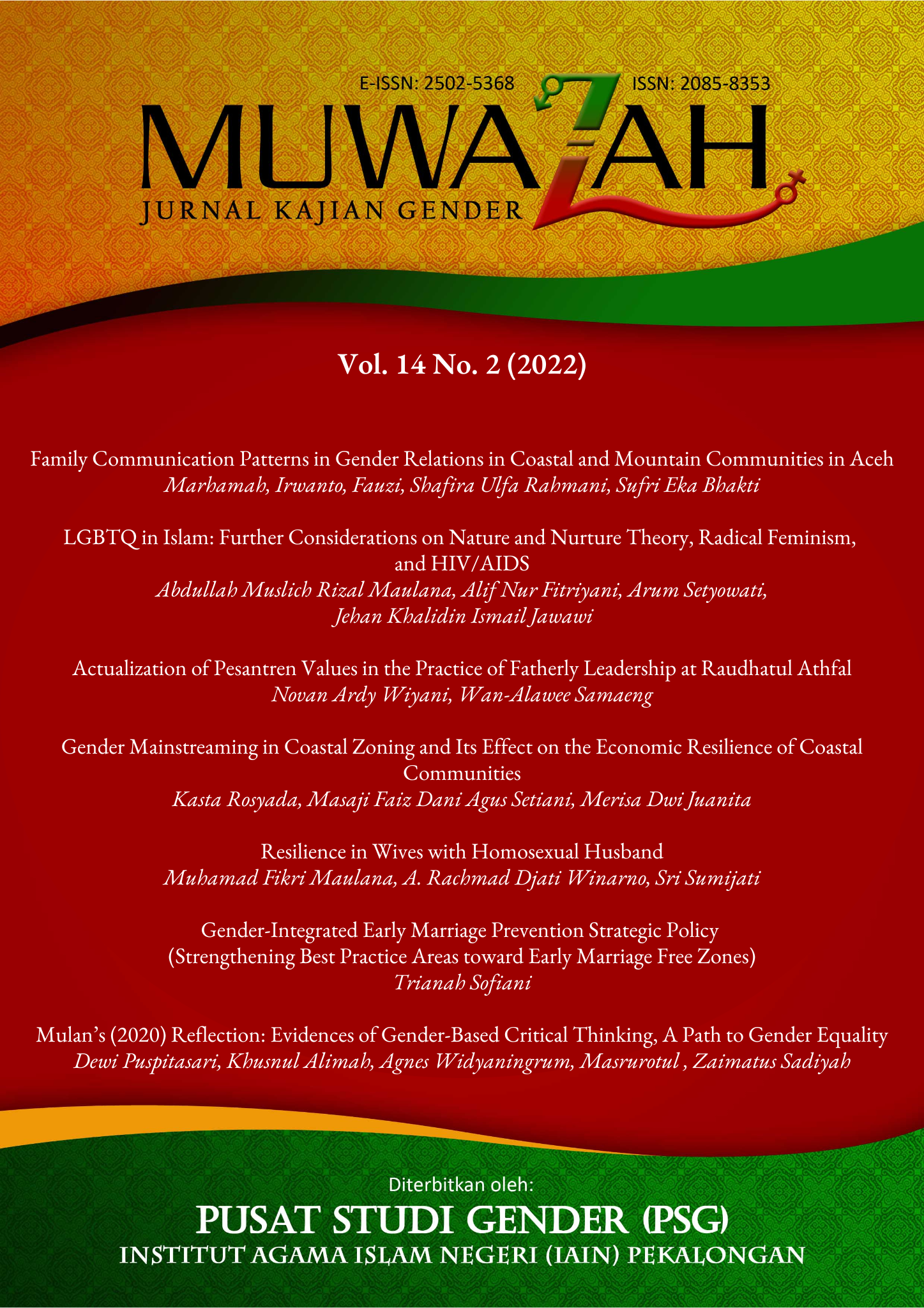
Family Communication Patterns in Gender Relations in Coastal and Mountain Communities in Aceh
DOI:
https://doi.org/10.28918/muwazah.v14i2.1085Abstract
This study explores the dynamics of gender relations and family communication patterns in coastal and mountain communities in Aceh to understand how family harmony is maintained in different socio-geographical contexts. Employing a qualitative phenomenological approach, data were collected through interviews, observations, focus group discussions, and documentation involving 20 families—10 from North Aceh District and 10 from Central Aceh District. This research is grounded in the analysis of gender partnership concepts and communication orientation theories. Data validation employed source triangulation, and analysis was conducted using the Miles and Huberman model, including data reduction, display, and verification. The findings reveal that mountain communities implement gender partnership models in the division of domestic and public roles, promoting equality. In contrast, coastal communities maintain a more traditional division of roles, with women in domestic and men in public spheres, albeit adaptively. Decision-making predominantly remains with male heads of families in both communities, though collaborative consultation is evident. Communication patterns differ: coastal communities display patterns of equality and imbalanced separation, whereas mountain communities emphasize balanced separation through traditional practices like manganese iyo. These patterns foster mutual understanding, openness, and trust, contributing significantly to family harmony and reducing divorce rates.
Keywords:
References
Aminullah, F. (2015). Patterns Of Gender Rela Tions On Women Migrant Workers Family In Th E Pekalongan Regency. Muwazah, Jurnal Kajian Gender, 7(2), 172–196. https://doi.org/https://doi.org/10.28918/muwazah.v7i2.521
Ascan, F.K. & Anne, M. . (2002). Family Communication. Communication Theory, 12(1), 70-91.
Bahfiarti Tuti. (2016). Komunikasi Keluarga (Suatu Pendekatan Keberlanjutan Regenerasi Anak Petani Kakao di Provinsi Sulawesi Selatan). Kedai Buku Jenny. Makassar.
Ciptyaningrum, E. W. (2021). rinsip Kemitraan Gender Dalam Keluarga (Analisis Kesetaraan Gender Pada Keluarga Tukang Pijat Panggilan). IAIN Ponorogo.
Devito, J. A. (2019). Fiftheenth Edition The Interpersonal Communication Book. 1–20.
Fakih, M. (2013). Analisis Gender & Transformasi Sosial,. Pustaka Pelajar.
Fadhilah, N. (2017). Pengembangan Model Bimbingan Kelompok Berbasis Islami untuk Meningkatkan Kecerdasan Emosional Siswa. Jurnal penelitian, 111-130.
Fadhilah, N. (2021). Role-Play: A Freedom To Learn Approach In Developing Children Emotional Intelligence. In Proceeding International Conference on Islam and Education (ICONIE) (Vol. 1, No. 1, pp. 181-201).
Gerungan, W. (2015). Psikologi Sosial (2nd ed.). Refika Aditama.
Goo, S. G. (2018). Masyarakat pegunungan tengah di kota jayapura di antara budaya kfc dan barapen. Jurnal Inovasi, 12(2), 88–95.
Gunarsa. (2007). Psikologi Perkembangan untuk Keluarga. BPK Gunung Mulia.
Hana, F., & Nara, M. (2021). Identitas Gender Anak Dalam Bingkai Komunikasi Orangtua Di Kota Kupang. Jurnal Communio: Jurnal Ilmu Komunikasi, 10(1), 27–38.
Hawari, D. (2015). Ilmu kedokteran jiwa dan kesehatan jiwa: perpektif Al-qur’an dan As-sunnah (2nd ed.). BP FKUI.
Hubeis, A. V. S. (2011). Pemberdayaan perempuan dari masa ke masa. PT Penerbit IPB Press.
Ihza, I. M., & Fadhilah, N. (2022). Psychoeducation Implementation of The Society in Early Marriage Prevention in the Songgodadi Village. In Proceeding International Conference on Islam and Education (ICONIE) (Vol. 2, No. 1).
Johnson, M. D. (2016). Great myths of intimate relationships: Dating, sex, and marriage. John Wiley & Sons.
Koerner, Ascan F & Mary Anne, F. (2002). Understanding Family Communication Patterns and Family Functioning: The Roles of Conversation Orientation and Conformity Orientation. Annals of the International Communication Association, 26(1), 36-65. https://doi.org/https://doi.org/10.1080/23808985.2002.11679010
Koerner, F, A. & M. A. F. (2002). Journal Article Toward a Theory of Family Communication. Communication Theory, 12(1), 70–91. https://doi.org/https://doi.org/10.1111/j.1468-2885.2002.tb00260.x
Koerner, A. F. & P. S. (2014). An Introduction to the Special Issue on Family Communication Patterns Theory. Journal of Family Communication, 14(1), 1-15. https://doi.org/https://doi.org/10.1080/15267431.2013.857328
Lestari, S. (2016). Psikologi Keluarga: Penanaman Nilai dan Penanaman Konflik dalam Keluarga. (1st ed.). Prenada Media.
Littlejohn, Stephen W., K. A. F. (2017). Theories of Human Communication. Waveland Press.
Mustaffa, N., Sannusi, S. N., & Markom, R. (2021). Family Communication and the Choice of a Life Partner Among Youths in Malaysia. Jurnal Komunikasi: Malaysian Journal of Communication, 37(1), 28–41. https://doi.org/https://doi.org/10.17576/JKMJC-2021-3701-02
Nuraida, N., & Zaki, M. (2018). Pola Komunikasi Gender Dalam Keluarga. Wardah, 18(2), 181. https://doi.org/10.19109/wardah.v18i2.1780
Odenweller, K. G., Rittenour, C. E., Myers, S. A., & Brann, M. (2013). Father-son family communication patterns and gender ideologies: A modeling and compensation analysis. Journal of family communication, 13(4), 340-357.
Poppel, M. K. (2015). Are Women Taking over Power and Labour from Men? Gender Relations in Pre- and Post-colonial Greenland. NORA - Nordic Journal of Feminist and Gender Research, 23(4), 303-312. https://doi.org/https://doi.org/10.1080/08038740.2015.1091546
Praniti, S. R. (2019). Pola komunikasi keluarga sakinah: Studi fenomenologi terhadap pemenang pemilihan keluarga sakinah teladan tingkat Kota Bandung Tahun 2015. Bandung: UIN Sunan Gunung Djati.
Puspitawati, H. (2012). Gender dan Keluarga: Konsep dan Realita Indonesia. PT Penerbit IPB Press.
Rahmawati, Rahmawati, M. G. (2018). Pola Komunikasi Dalam Keluarga. Jurnal Al-Munzir, 11(2), 327–245.
Rofi’ah, S. (2015). Membangun Pola Relasi Kelu Arga Berbasis Kesetaraan Dan Keadilan Gender. Muwazah, Jurnal Kajian Gender, 7(2), 93–107. https://doi.org/https://doi.org/10.28918/muwazah.v7i2.515
Sadhali. (2022). Angka Perceraian di Aceh 2021 Capai 6.448 Perkara, Banyak istri Gugat Suami. Rri.Co.Id.
Satria, A. (2015). Pengantar sosiologi masyarakat pesisir. Yayasan Pustaka Obor Indonesia,.
Sholeh, Muhammad, and G. J. (2022). Studi Gender dalam Komunikasi Keluarga: Problematik yang Dihadapi Remaja Perempuan dalam Pengambilan Keputusan. Deas: Jurnal Pendidikan, Sosial, Dan Budaya, 8(1), 97-108.
Sumiyatiningsih, D. (2014). “Pergeseran peran laki-laki dan perempuan dalam kajian feminis.” WASKITA, Jurnal Studi Agama Dan Masyarakat, 139–151.
Supaat, S. F. (2019). The Muslim Millennial family typology: the role of Muslim family circumflex model to avoid parents’ violent behavior against children in Indonesia. Indonesian Journal of Islam and Muslim Societies, 9(1), 57–81. https://doi.org/0.18326/ijims.v9i1. 57-81
Terry, A. (2016). Reconceptualizing gender: a historical perspective from structure to process and intersectionality. Journal of Research in Gender Studies, 6(2), 69-82. https://doi.org/10.22381/JRGS6220164
Tirtawinata, C. M. (2013). “Mengupayakan keluarga yang harmonis.” Jurnal Humaniora, 4(2), 1141-1151.
Downloads
Published
License
Copyright (c) 2022 MUWAZAH: Jurnal Kajian Gender

This work is licensed under a Creative Commons Attribution 4.0 International License.