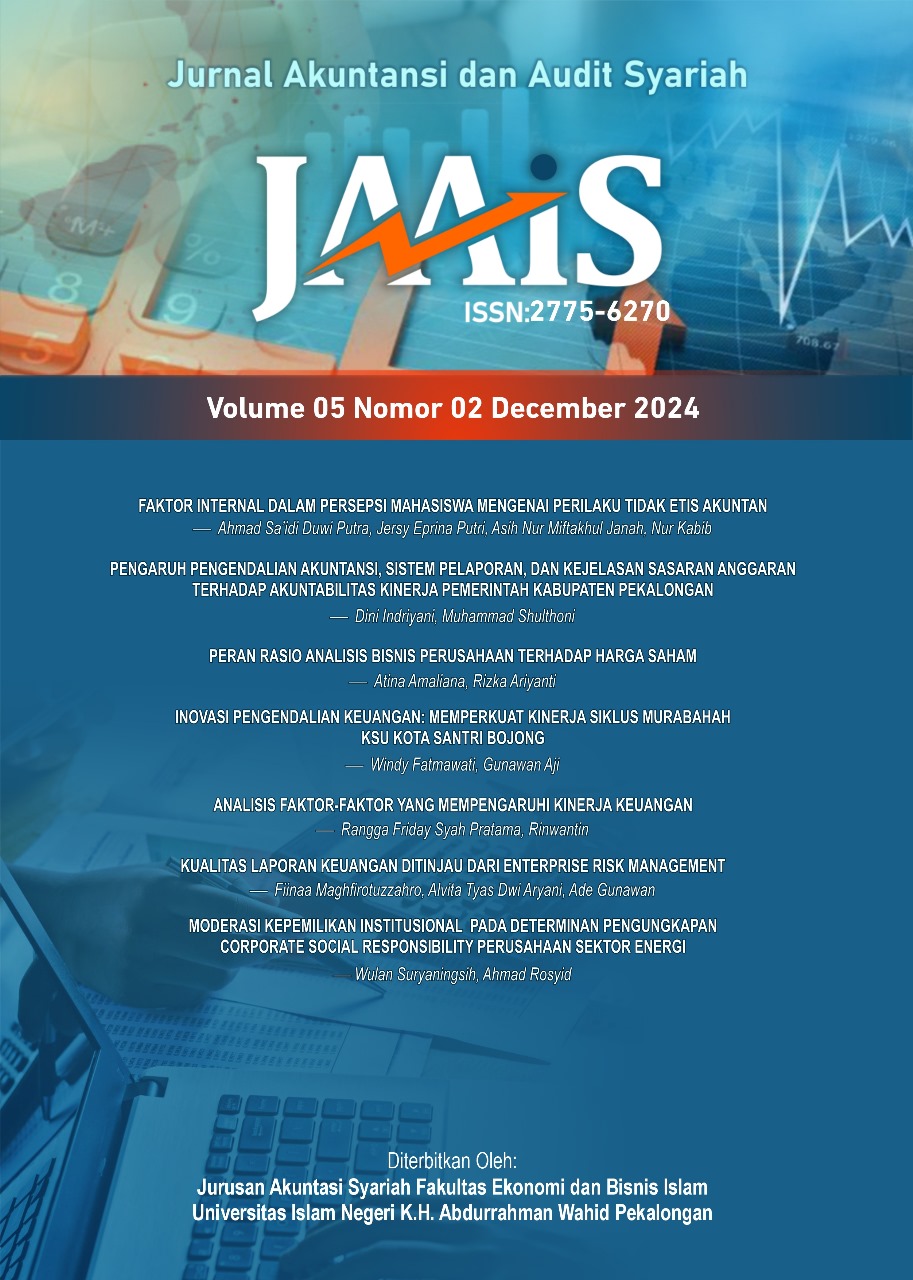
Kualitas Laporan Keuangan Ditinjau dari Enterprise Risk Management
DOI:
https://doi.org/10.28918/jaais.v5i2.9096Abstract
Financial reports play a crucial role for external parties in monitoring company performance, tracking growth, and evaluating achievements. However, pressure to make reports appealing to prospective investors and stakeholders often leads to financial statement manipulation. Stakeholder theory asserts that financial reports are needed by various parties to assess company operations and aid in investment decision-making. Nevertheless, this manipulation can result in a mismatch between external expectations of neutral reports and company practices of embellishing financial statements. This study aims to provide a deeper understanding of how Intellectual Capital, Sustainability Reports, and Tax Planning affect the quality of financial reports, moderated by Enterprise Risk Management, in the transportation and logistics sector companies listed on the Indonesia Stock Exchange (BEI) from 2019 to 2023. A causal-comparative method is employed with a quantitative approach and data collection from company financial reports and annual reports from 2019 to 2023. Moderated Regression Analysis (MRA) using Eviews 13 is the data analysis technique utilized. The research findings indicate that Intellectual Capital, Sustainability Reports, and Tax Planning influence the quality of financial reports. However, Enterprise Risk Management only moderates the influence of Sustainability Reports, weakening their impact on financial report quality, but not that of Intellectual Capital and Tax Planning.
References
Downloads
Published
License
Copyright (c) 2024 Fiinaa Maghfirotuzzahro, Alvita Tyas Dwi Aryani, Ade Gunawan

This work is licensed under a Creative Commons Attribution-ShareAlike 4.0 International License.