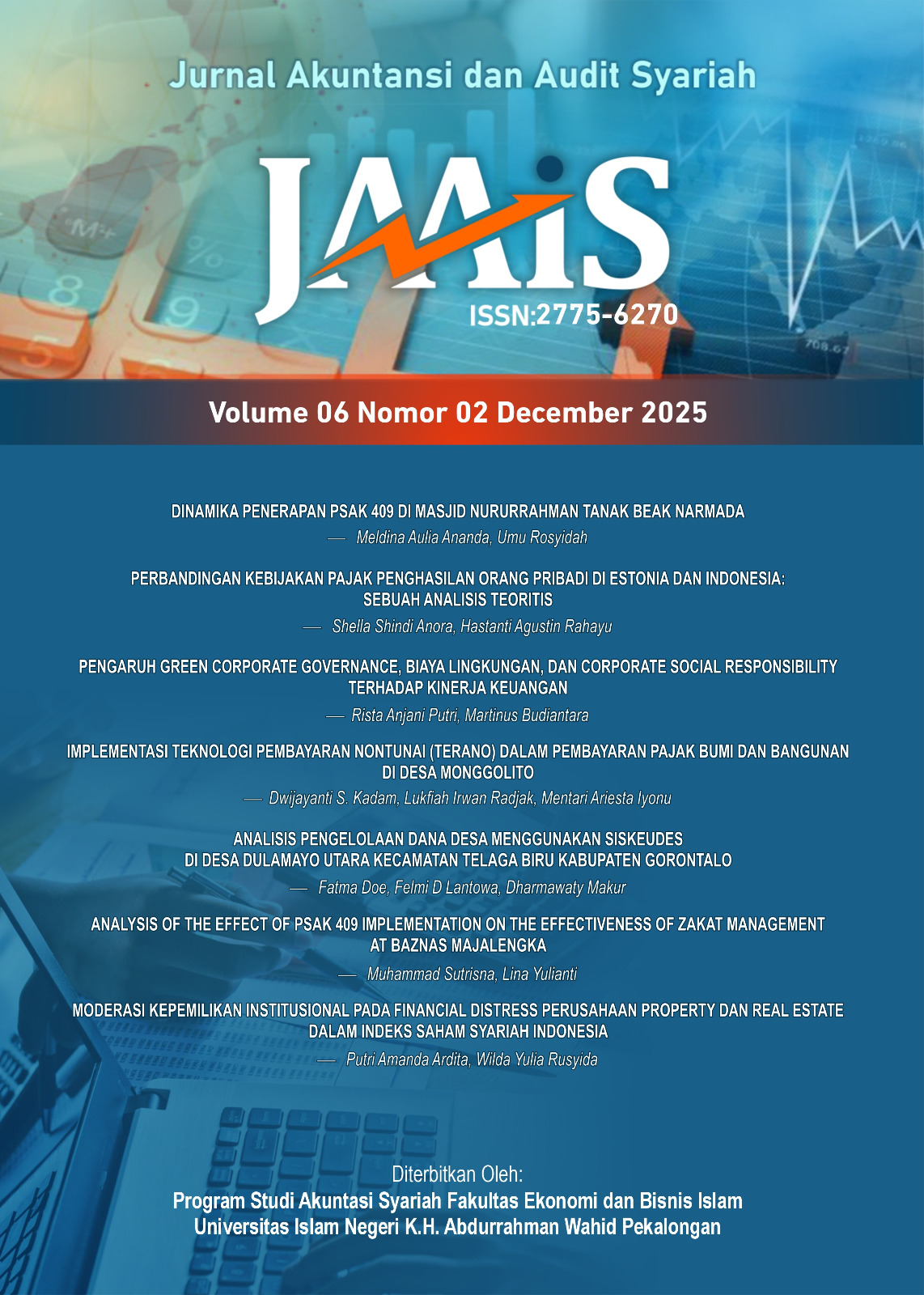
Moderasi Kepemilikan Institusional pada Financial Distress Perusahaan Property Dan Real Estate dalam Indeks Saham Syariah Indonesia
DOI:
https://doi.org/10.28918/jaais.v6i2.13331Abstract
Introduction/Main Objectives: : The main objective of this study is to analyze the effect of operating capacity, sales growth, and cash flow on financial distress, and to assess the extent to which institutional ownership can moderate the relationship between these variables. Background Problems: Rapid development in the modern era has led to increasingly fierce competition between companies, both at the national and international levels. This condition requires every company to continue to innovate and improve performance in order to survive and compete in the global market. If a company cannot manage its resources and assets optimally, it can cause financial distress that has the potential to lead to bankruptcy. To minimize this risk, it is necessary to analyze the factors that can influence financial distress. Several factors that play a role include operating capacity, sales growth, and cash flow. Operating capacity describes a company's ability to utilize assets efficiently to generate sales. Sales growth indicates a company's ability to increase revenue from the previous period, while cash flow reflects the company's ability to meet its financial obligations. In addition, institutional ownership is thought to be able to strengthen the influence of these factors on financial distress because it can act as a monitoring mechanism for company management. Novelty: This study empirically analyzes how these financial ratios affect financial distress in Property and Real Estate Companies in ISSI for the 2020-2024 financial reporting period. Research Methods: This study applies a quantitative approach and the data used are secondary data obtained from the annual reports of property and real estate companies listed in the Sharia Stock Index for the 2020- 2024 period. The sampling technique was carried out by purposive sampling and resulted in 16 companies. Data analysis was carried out using SPSS version 26 through the stages of descriptive statistical tests, classical assumption tests, multiple regression analysis tests, partial tests (t-tests), moderation regression analysis tests, and determinant tests. Finding/Results: The results of the study indicate that operating capacity and sales growth have an effect on financial distress, while cash flow has no effect on financial distress. Furthermore, institutional ownership is proven to be able to moderate the relationship between operating capacity and sales growth on financial distress. Also, cash flow cannot affect financial distress with institutional ownership as a moderating variable. Conclusion: This study concludes that a company's financial condition is influenced by its ability to efficiently manage operational capacity and sales growth. Cash flow is not yet a primary factor in determining a company's level of financial distress. Furthermore, institutional ownership plays a significant role in strengthening the relationship between internal company factors and the level of financial distress, thus institutional oversight is necessary to maintain the company's financial stability.
Keywords:
References
Downloads
Published
License
Copyright (c) 2025 Putri Amanda Ardita, Wilda Yulia Rusyida

This work is licensed under a Creative Commons Attribution-ShareAlike 4.0 International License.