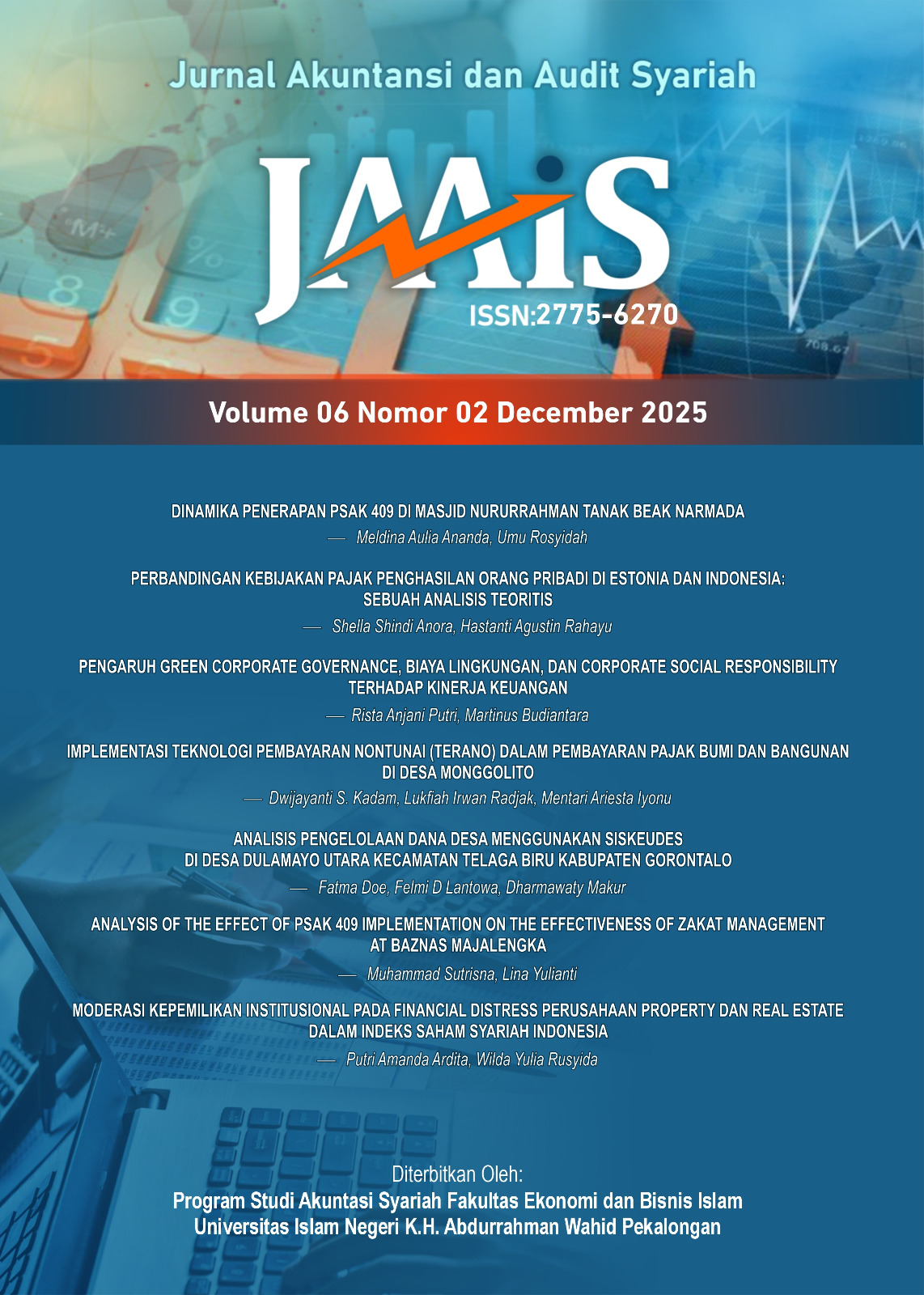
Perbandingan Kebijakan Pajak Penghasilan Orang Pribadi di Estonia dan Indonesia: Sebuah Analisis Teoritis
DOI:
https://doi.org/10.28918/jaais.v6i2.11341Abstract
This study aims to compare the personal income tax (PPh OP) policies between two countries, namely Estonia and Indonesia, with a qualitative approach to literature studies. This analysis is carried out based on a three-theory approach, namely tax compliance theory, tax justice theory, and fiscal administration efficiency theory. Indonesia implements a progressive tariff system guided by vertical justice and income redistribution. However, its implementation still faces several challenges, particularly in terms of administrative complexity and low tax literacy among the community. On the other hand, Estonia implements a fixed tariff system or flat tax of 20% which is supported by a fully digitalized and fully integrated system. This system is considered very superior because it is more efficient and provides ease of reporting as well as a high level of compliance. However, this system ignores the aspect of justice because of the same trif. The results of the study show that there is no completely ideal system, each country has its advantages and disadvantages. The practical implications of this study suggest the need for a PPh OP policy that balances technological efficiency with the principle of justice, taking into account the socio-economic characteristics of Indonesia.
Keywords:
References
Downloads
Published
License
Copyright (c) 2025 Shella Shindi Anora, Hastanti Agustin Rahayu

This work is licensed under a Creative Commons Attribution-ShareAlike 4.0 International License.